Reagent contamination can critically impact sequence-based microbiome analyses


Reagent contamination can critically impact sequence-based microbiome analyses

Susannah Salter, Michael J Cox, Elena M Turek, Szymon T Calus, William O Cookson, Miriam F Moffatt, Paul Turner, Julian Parkhill, Nick Loman, Alan W Walker

The study of microbial communities has been revolutionised in recent years by the widespread adoption of culture independent analytical techniques such as 16S rRNA gene sequencing and metagenomics. One potential confounder of these sequence-based approaches is the presence of contamination in DNA extraction kits and other laboratory reagents. In this study we demonstrate that contaminating DNA is ubiquitous in commonly used DNA extraction kits, varies greatly in composition between different kits and kit batches, and that this contamination critically impacts results obtained from samples containing a low microbial biomass. Contamination impacts both PCR-based 16S rRNA gene surveys and shotgun metagenomics. These results suggest that caution should be advised when applying sequence-based techniques to the study of microbiota present in low biomass environments. We provide an extensive list of potential contaminating genera, and guidelines on how to mitigate the effects of contamination. Concurrent sequencing of negative control samples is strongly advised.

No evidence that sex and transposable elements drive genome size variation in evening primroses

No evidence that sex and transposable elements drive genome size variation in evening primroses
J Arvid Agren, Stephan Greiner, Marc TJ Johnson, Stephen I Wright

Genome size varies dramatically across species, but despite an abundance of attention there is little agreement on the relative contributions of selective and neutral processes in governing this variation. The rate of sexual reproduction can potentially play an important role in genome size evolution because of its effect on the efficacy of selection and transmission of transposable elements. Here, we used a phylogenetic comparative approach and whole genome sequencing to investigate the contribution of sex and transposable element content to genome size variation in the evening primrose (Oenothera) genus. We determined genome size using flow cytometry from 30 Oenothera species of varying reproductive system and find that variation in sexual/asexual reproduction cannot explain the almost two-fold variation in genome size. Moreover, using whole genome sequences of three species of varying genome sizes and reproductive system, we found that genome size was not associated with transposable element abundance; instead the larger genomes had a higher abundance of simple sequence repeats. Although it has long been clear that sexual reproduction may affect various aspects of genome evolution in general and transposable element evolution in particular, it does not appear to have played a major role in the evening primroses.

Mitochondrial Genomes of Domestic Animals Need Scrutiny


Mitochondrial Genomes of Domestic Animals Need Scrutiny

Ni-Ni Shi, Long Fan, Yong-Gang Yao, Min-Sheng Peng, Ya-Ping Zhang
(Submitted on 16 Jul 2014)

More than 1000 complete or near-complete mitochondrial DNA (mtDNA) sequences have been deposited in GenBank for eight common domestic animals (i.e. cattle, dog, goat, horse, pig, sheep, yak and chicken) and their close wild ancestors or relatives. Nevertheless, few efforts have been performed to evaluate the sequence data quality, which heavily impact the original conclusion. Herein, we conducted a phylogenetic survey of these complete or near-complete mtDNA sequences based on mtDNA haplogroup trees for the eight animals. We show that, errors due to artificial recombination, surplus of mutations, and phantom mutations, do exist in 14.5% (194/1342) of mtDNA sequences and shall be treated with wide caution. We propose some caveats for mtDNA studies of domestic animals in the future.

THE GENETIC LANDSCAPE OF TRANSCRIPTIONAL NETWORKS IN A COMBINED HAPLOID/DIPLOID PLANT SYSTEM

THE GENETIC LANDSCAPE OF TRANSCRIPTIONAL NETWORKS IN A COMBINED HAPLOID/DIPLOID PLANT SYSTEM
Jukka-Pekka Verta, Christian R Landry, John J MacKay

Heritable variation in gene expression is a source of evolutionary change and our understanding of the genetic basis of expression variation remains incomplete. Here, we dissected the genetic basis of transcriptional variation in a wild, outbreeding gymnosperm (Picea glauca) according to linked and unlinked genetic variants, their allele-specific (cis) and allele non-specific (trans) effects, and their phenotypic additivity. We used a novel plant system that is based on the analysis of segregating alleles of a single self-fertilized plant in haploid and diploid seed tissues. We measured transcript abundance and identified transcribed SNPs in 66 seeds with RNA-seq. Linked and unlinked genetic effects that influenced expression levels were abundant in the haploid megagametophyte tissue, influencing 48% and 38% of analyzed genes, respectively. Analysis of these effects in diploid embryos revealed that while distant effects were acting in trans consistent with their hypothesized diffusible nature, local effects were associated with a complex mix of cis, trans and compensatory effects. Most cis effects were additive irrespective of their effect sizes, consistent with a hypothesis that they represent rate-limiting factors in transcript accumulation. We show that trans effects fulfilled a key prediction of Wright?s physiological theory, in which variants with small effects tend to be additive and those with large effects tend to be dominant/recessive. Our haploid/diploid approach allows a comprehensive genetic dissection of expression variation and can be applied to a large number of wild plant species.

Clades and clans: a comparison study of two evolutionary models

Clades and clans: a comparison study of two evolutionary models
Sha Zhu, Cuong Than, Taoyang Wu
Comments: 21pages
Subjects: Populations and Evolution (q-bio.PE)

The Yule-Harding-Kingman (YHK) model and the proportional to distinguishable arrangements (PDA) model are two binary tree generating models that are widely used in evolutionary biology. Understanding the distributions of clade sizes under these two models provides valuable insights into macro-evolutionary processes, and is important in hypothesis testing and Bayesian analyses in phylogenetics. Here we show that these distributions are log-convex, which implies that very large clades or very small clades are more likely to occur under these two models. Moreover, we prove that there exists a critical value $\kappa(n)$ for each $n\geqslant 4$ such that for a given clade with size $k$, the probability that this clade is contained in a random tree with $n$ leaves generated under the YHK model is higher than that under the PDA model if $1<k<\kappa(n)$, and lower if $\kappa(n)<k<n$. Finally, we extend our results to binary unrooted trees, and obtain similar results for the distributions of clan sizes.

Analysis of Algorithms for Determining and Quantifying Full-length mRNA Splice Forms from RNA-Seq Data

Benchmark Analysis of Algorithms for Determining and Quantifying Full-length mRNA Splice Forms from RNA-Seq Data
Katharina Hayer, Angel Pizzaro, Nicholas L Lahens, John B Hogenesch, Gregory R Grant

The advantages of RNA sequencing (RNA-Seq) suggest it will replace microarrays for highly parallel gene expression analysis. For example, in contrast to arrays, RNA-Seq is expected to be able to provide accurate identification and quantification of full-length transcripts. A number of methods have been developed for this purpose, but short error prone reads makes it a difficult problem in practice. It is essential to determine which algorithms perform best, and where and why they fail. However, there is a dearth of independent and unbiased benchmarking studies of these algorithms. Here we take an approach using both simulated and experimental benchmark data to evaluate their accuracy. We conclude that most methods are inaccurate even using idealized data, and that no is method sufficiently accurate once complicating factors such as polymorphisms, intron signal, sequencing error, and multiple splice forms are present. These results point to the pressing need for further algorithm development.

Stress-Induced Mutagenesis and Complex Adaptation

Stress-Induced Mutagenesis and Complex Adaptation
Yoav Ram, Lilach Hadany
(Submitted on 14 Jul 2014)

Because mutations are mostly deleterious, mutation rates should be reduced by natural selection. However, mutations also provide the raw material for adaptation. Therefore, evolutionary theory suggests that the mutation rate must balance between adaptability – the ability to adapt – and adaptedness – the ability to remain adapted. We model an asexual population crossing a fitness valley and analyze the rate of complex adaptation with and without stress-induced mutagenesis – the increase of mutation rates in response to stress or maladaptation. We show that stress-induced mutagenesis increases the rate of complex adaptation without reducing the population mean fitness, thus breaking the evolutionary trade-off between adaptability and adaptedness. Our theoretical results support the hypothesis that stress-induced mutagenesis promotes adaptation and provide quantitative predictions of the rate of complex adaptation with different mutational strategies.

Bayesian Structured Sparsity from Gaussian Fields


Bayesian Structured Sparsity from Gaussian Fields

Barbara E. Engelhardt, Ryan P. Adams
(Submitted on 8 Jul 2014)

Substantial research on structured sparsity has contributed to analysis of many different applications. However, there have been few Bayesian procedures among this work. Here, we develop a Bayesian model for structured sparsity that uses a Gaussian process (GP) to share parameters of the sparsity-inducing prior in proportion to feature similarity as defined by an arbitrary positive definite kernel. For linear regression, this sparsity-inducing prior on regression coefficients is a relaxation of the canonical spike-and-slab prior that flattens the mixture model into a scale mixture of normals. This prior retains the explicit posterior probability on inclusion parameters—now with GP probit prior distributions—but enables tractable computation via elliptical slice sampling for the latent Gaussian field. We motivate development of this prior using the genomic application of association mapping, or identifying genetic variants associated with a continuous trait. Our Bayesian structured sparsity model produced sparse results with substantially improved sensitivity and precision relative to comparable methods. Through simulations, we show that three properties are key to this improvement: i) modeling structure in the covariates, ii) significance testing using the posterior probabilities of inclusion, and iii) model averaging. We present results from applying this model to a large genomic dataset to demonstrate computational tractability.

On the number of ranked species trees producing anomalous ranked gene trees

On the number of ranked species trees producing anomalous ranked gene trees
Filippo Disanto, Noah A. Rosenberg
Subjects: Populations and Evolution (q-bio.PE)

Analysis of probability distributions conditional on species trees has demonstrated the existence of anomalous ranked gene trees (ARGTs), ranked gene trees that are more probable than the ranked gene tree that accords with the ranked species tree. Here, to improve the characterization of ARGTs, we study enumerative and probabilistic properties of two classes of ranked labeled species trees, focusing on the presence or avoidance of certain subtree patterns associated with the production of ARGTs. We provide exact enumerations and asymptotic estimates for cardinalities of these sets of trees, showing that as the number of species increases without bound, the fraction of all ranked labeled species trees that are ARGT-producing approaches 1. This result extends beyond earlier existence results to provide a probabilistic claim about the frequency of ARGTs.

Author post: Hybrid origins and the earliest stages of diploidization in the highly successful recent polyploid Capsella bursa-pastoris

This guest post is by Gavin Douglas (@gmdougla), Stephen Wright (@stepheniwright), and Tanja Slotte (@tanjaslotte) on their paper Douglas et al. Hybrid origins and the earliest stages of diploidization in the highly successful recent polyploid Capsella bursa-pastoris. bioRxived here.
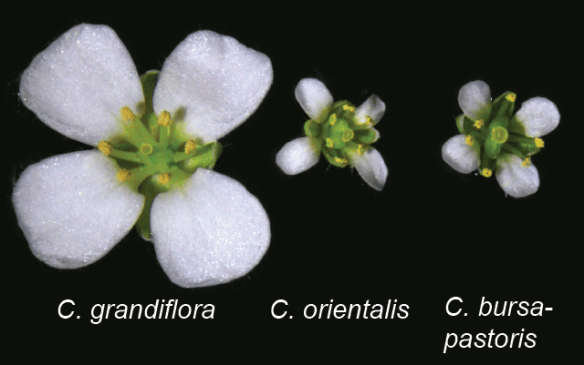
photo credit: Tanja Slotte

photo credit: Tanja Slotte


In this preprint we investigate the mode of origin and evolutionary consequences of polyploidy in the highly successful tetraploid plant Capsella bursa-pastoris. We analyze high-coverage massively parallel genomic sequence data and first show that C. bursa-pastoris is a recent hybrid of two Capsella lineages leading to C. grandiflora and C. orientalis. This settles a long-standing uncertainty regarding the origins of C. bursa-pastoris. Second, we investigate patterns of nonfunctionalization and gene loss, and while we find little evidence for rapid, massive genome-wide fractionation, our analyses suggest that there is a decrease in the efficacy of selection in this recently formed tetraploid.

Allopolyploid origins of Capsella bursa-pastoris

Determining the evolutionary origin of C. bursa-pastoris has proven to be difficult and many contradictory hypotheses have been suggested, including that the tetraploid is an autopolyploid of a single Capsella species. Part of the complication has been the relatively low levels of sequence divergence between homeologous gene copies, and across the diploid Capsella lineages. Given population genomic sequences from all three Capsella species mentioned, we were able to address this question again with several different approaches.
C. bursa-pastoris undergoes disomic inheritance, meaning that genes duplicated as a result of polyploidy (homeologs) are independently inherited. Thus, one of the major tasks with our genomic data was to partition out the sequences from the two homeologous subgenomes. Because of the low levels of sequence divergence between homeologs (3% on average), this can be a challenging task. We took two approaches to generate phased genome sequence for inferring species origins; de novo assembly of short reads and phasing of SNPs from mapping reads to the reference genome of the diploid Capsella rubella. Phylogenetic trees generated from de novo assemblies of these species overwhelmingly support one C. bursa-pastoris homeolog forming a clade with C. grandiflora and the other with C. orientalis. The distribution of SNPs and transposable elements shared between these species also strongly support this hybridization model, which we estimate occurred within the last 100-300,000 years.
One reason the hybrid origins of C. bursa-pastoris is exciting is due to the divergent evolution of its progenitor lineages. C. orientalis and C. grandiflora differ both in their mating system and geographical distribution. Given that C. bursa-pastoris is a highly successful weed found worldwide, it will be interesting in future work to assess whether this divergence between the C. orientalis and C. grandiflora lineages contributed to the tetraploid’s adaptability.

Decreased efficacy of selection in the recently arisen polyploid
Following genome duplications the majority of redundant loci are expected to become lost over time through the process of diploidization. This model has been supported by several ancient polyploid events, including in Arabidopsis. Capsella bursa-pastoris presents an interesting model for studying the early phases of diploidization, and allows for an investigation of the rate of gene loss as well as the relative importance of relaxed selection vs. positive selection during early stages of gene inactivation. We searched for large deletions spanning genes using several approaches both based on determination of exact breakpoints and by cross-referencing low-coverage regions in C. bursa-pastoris with other Capsella species. Although we identified proportionately more large deletions segregating in C. bursa-pastoris than in the diploids, we did not find evidence for massive genomic changes in the tetraploid.
We were able to demonstrate relaxation of selection by analyzing the site frequency spectrum of SNPs segregating at 0-fold nonsynonymous sites in the three Capsella species. We also investigated SNPs causing putatively deleterious effects, such as premature stop codons, segregating in the three Capsella. Many of these SNPs are shared between the three species, although segregating at low frequencies in C. grandiflora. Since this shared deleterious variation inherited from progenitors seems to be responsible for a large proportion of the earliest stages of gene degeneration, this data supports a model of genome fractionation that is given a “head start” from standing variation. A key message following from this result is that we should be giving more weight to purely historical explanations of gene loss when studying biased fractionation.