Rolling the Dice Twice: Evolving Reconstructed Ancient Proteins in Extant Organisms

Rolling the Dice Twice: Evolving Reconstructed Ancient Proteins in Extant Organisms

Betul Kacar

Assortment and the evolution of cooperation in a Moran process with exponential fitness

Assortment and the evolution of cooperation in a Moran process with exponential fitness
Daniel Cooney, Carl Veller

We study the evolution of cooperation in a finite population interacting according to a simple model of like-with-like assortment. Evolution proceeds as a Moran process, and payoffs from the underlying cooperator-defector game are translated to positive fitnesses by an exponential transformation. The use of the exponential transformation, rather than the usual linear one, allows for a tractable characterization of the effect of assortment on the evolution of cooperation. We define two senses in which a greater degree of assortment can favour the evolution of cooperation, the first stronger than the second: (i) greater assortment increases, at all population states, the probability that the number of cooperators increases, relative to the probability that the number of defectors increases; and (ii) greater assortment increases the fixation probability of cooperation, relative to that of defection. We show that, even by the stronger definition, greater assortment favours the evolution of cooperation for many cooperative dilemmas of interest, including prisoners’ dilemmas, snowdrift games, and stag-hunt games. For other cooperative dilemmas, greater assortment favours cooperation by the weak definition, but not by the strong definition. Allen and Nowak (2015) have derived similar results for a Wright-Fisher process with assortment. Our results complement theirs, and extend them in two ways: First, while their results hold only for weak selection, our results hold for any strength of selection. Second, while their results apply only to the weak definition by which assortment favours cooperation, we derive results for the strong definition too.

Diverse phenotypic and genetic responses to short-term selection in evolving Escherichia coli populations

Diverse phenotypic and genetic responses to short-term selection in evolving Escherichia coli populations

Marcus M Dillon, Nicholas P Rouillard, Brian Van Dam, Romain Gallet, Vaughn S Cooper

The UCSC Genome Browser database: 2016 update

The UCSC Genome Browser database: 2016 update

Matthew Speir, Ann S. Zweig, Kate R. Rosenbloom, Brian J. Raney, Benedict Paten, Parisa Nejad, Brian T. Lee, Katrina Learned, Donna Karolchik, Angie S. Hinrichs, Steve Heitner, Rachel A. Harte, Maximilian Haeussler, Luvina Guruvadoo, Pauline A. Fujita, Christopher Eisenhart, Mark Diekhans, Hiram Clawson, Jonathan Casper, Galt P. Barber, David Haussler, Robert M. Kuhn, W. James Kent

Structure and evolutionary history of a large family of NLR proteins in the zebrafish

Structure and evolutionary history of a large family of NLR proteins in the zebrafish

Kerstin Howe, Philipp Schiffer, Julia Zielinski, Thomas Wiehe, Gavin Laird, John Marioni, Onuralp Soylemez, Fyodor Kondrashov, Maria Leptin

Assessment of the potential impacts of plant traits across environments by combining global sensitivity analysis and dynamic modeling in wheat

Assessment of the potential impacts of plant traits across environments by combining global sensitivity analysis and dynamic modeling in wheat
Pierre Casadebaig, Bangyou Zheng, Scott Chapman, Neil Huth, Robert Faivre, Karine Chenu

A crop can be viewed as a complex system with outputs (e.g. yield) that are affected by inputs of genetic, physiology, pedo-climatic and management information. Application of numerical methods for model exploration assist in evaluating the major most influential inputs, providing the simulation model is a credible description of the biological system. A sensitivity analysis was used to assess the simulated impact on yield of a suite of traits involved in major processes of crop growth and development, and to evaluate how the simulated value of such traits varies across environments and in relation to other traits (which can be interpreted as a virtual change in genetic background). The study focused on wheat in Australia, with an emphasis on adaptation to low rainfall conditions. A large set of traits (90) was evaluated in a wide target population of environments (4 sites x 125 years), management practices (3 sowing dates x 2 N fertilization) and CO2 (2 levels). The Morris sensitivity analysis method was used to sample the parameter space and reduce computational requirements, while maintaining a realistic representation of the targeted trait x environment x management landscape (∼ 82 million individual simulations in total). The patterns of parameter x environment x management interactions were investigated for the most influential parameters, considering a potential genetic range of +/- 20% compared to a reference. Main (i.e. linear) and interaction (i.e. non-linear and interaction) sensitivity indices calculated for most of APSIM-Wheat parameters allowed the identifcation of 42 parameters substantially impacting yield in most target environments. Among these, a subset of parameters related to phenology, resource acquisition, resource use efficiency and biomass allocation were identified as potential candidates for crop (and model) improvement.

Author post: Immunosequencing reveals diagnostic signatures of chronic viral infection in T cell memory

This guest post is by William DeWitt on his preprint (with co-authors) “Immunosequencing reveals diagnostic signatures of chronic viral infection in T cell memory”.

This is a post about our preprint at biorXiv. Although it’s a paper on infectious disease and immunology, our colleague (and Haldane’s Sieve contributor) Bryan Howie suggested we might engage the community here, since we think there are interesting connections to standard GWAS methodology. I’ll start with a one-paragraph immunology primer, then summarize what we’ve been up to, and what’s next.

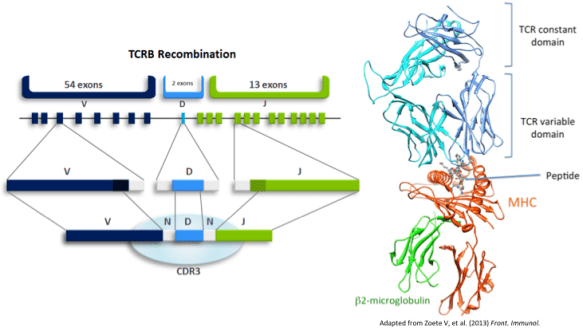
Cell-mediated adaptive immunity is effected by T cells, which recognize infection through interface of the T cell receptor (TCR) with foreign peptides presented on the surface of all nucleated cells by major histocompatibility complex (MHC). During development in the thymus, maturing T cells somatically generate genes encoding the TCR according to a random process of V(D)J recombination and are passed through selective barriers against weak MHC affinity (positive selection) and strong self-peptide affinity (negative selection). This results in a diverse repertoire of self-tolerant receptors from which to deploy specific responses to threats from a protean universe of evolving pathogens. Upon recognition of foreign antigen, a T cell proliferates, generating a subpopulation with identical-by-descent TCRs. This clonal selection mechanism of immunological memory implies that the TCR repertoire dynamically encodes an individual’s pathogen exposure history, and suggests that infection with a given pathogen could be recognized by identifying concomitant TCRs.
f1

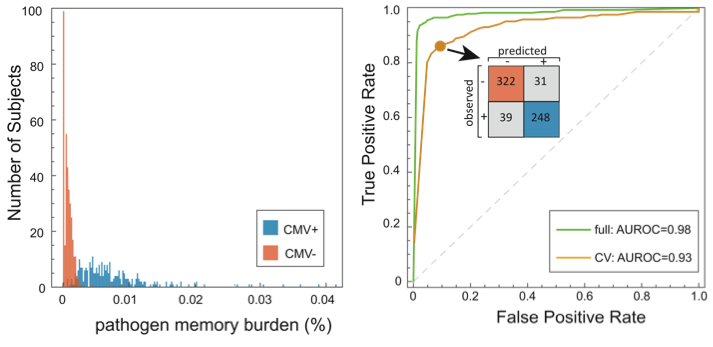
In this study, we identify signatures of viral infection in the TCR repertoire. With a cohort of 640 subjects, we performed high-throughput immunosequencing of rearranged TCR genes, and serostatus tests for cytomegalovirus (CMV) infection. We used an analysis approach similar to GWAS; among the ~85 million unique TCRs in these data, we tested for enrichment of specific TCRs among CMV seropositive subjects, identifying a set of CMV-associated TCRs. These were reduced to a single dimension by defining the pathogen memory burden as the fraction of an individual’s TCRs that are CMV-associated, revealing a powerful discriminator. A binary classifier trained against this quantity demonstrated high cross validation accuracy.

f2

The binding of TCR to antigen is mediated by MHC, which is encoded by the highly polymorphic HLA loci. Thus, the affinity of a given TCR for a given antigen is modulated by HLA haplotype. HLA typing was performed for this cohort according to standard methods, and we investigated enrichment of specific HLA alleles among the subjects in which each CMV-associated TCR appeared. Most CMV-associated TCRs were found to have HLA restrictions, and none were associated with more than one allele in any locus.

There is substantial literature identifying TCRs that bind CMV antigen through low-throughput in vitro methods, including so-called public TCRs, which arise in many individuals. Most public CMV TCRs were present in our data, however most were not in our list of diagnostically useful CMV-associated TCRs. This is understood by considering that V(D)J recombination produces different TCRs with different probability. Public TCRs, having high recombination probability, will be repeatedly recombined in the repertoires of all subjects, regardless of CMV infection status; their presence is not diagnostic for CMV serostatus, even if they are CMV-avid. Conversely, CMV-avid TCRs with low recombination probability will be private to one subject (if present at all) in any cohort of reasonable size; their enrichment in CMV seropositive subjects is not detectable. CMV-avid TCRs with intermediate recombination probability recombine intermittently, residing transiently in the repertoires CMV naïve individuals and reliably proliferating upon CMV exposure; the presence of these TCRs in an immunosequencing sample is diagnostic for infection status.

It may be interesting to draw a comparison with GWAS, where selection drives disease-associated variants with high effect size to low population frequency, out of reach of the detection power of any study. In contrast, the V(D)J recombination machinery is constant across individuals, and CMV-avid TCRs appear to span a broad range of recombination probabilities from public to private. This includes plenty in an intermediate regime of what we might call diagnostic TCRs, which can be used to build powerful classifiers of disease status that aren’t blunted by suppression of the most relevant features.

We’ll be making the data from this study available online, constituting the largest publically accessible TCR immunosequencing data set. It’ll be fun to see what other groups do with it.

Some things we’re still working on:
• We did cross validation to assess diagnostic accuracy (yellow curve in the ROC figure), including recomputation of CMV-associated TCRs for each holdout. Results are encouraging, but a more convincing test will be to diagnose a separate cohort. We’re in the process of acquiring these data.
• MHC polymorphism suggests that thymic selection barriers censor different TCRs in individuals with different HLA haplotype. We’ve done preliminary work identifying TCRs that are associated with more common HLA alleles, indicating the possibility of HLA typing from immunosequencing data. Interestingly, this necessitates a two-tailed test due to modulation of both positive and negative selection.
• Our association analysis relies on the recurrence of TCRs with identical amino acid sequence across individuals, but we’d like to be able to define TCR motifs more loosely, so that we can detect enrichment without requiring identity. This necessitates a similarity metric in amino acid space that captures similarity in avidity. We have some ideas here, and are testing them out on some validation data. It’s definitely a tough one, but could substantially increase power in this sort of study.
Inference of complex population histories using whole-genome sequences from multiple populations

Inference of complex population histories using whole-genome sequences from multiple populations

Matthias Steinrücken, John A. Kamm, Yun S. Song

Improved metagenome assemblies and taxonomic binning using long-read circular consensus sequence data

Improved metagenome assemblies and taxonomic binning using long-read circular consensus sequence data

Jeremy A. Frank, Yao Pan, Ave Tooming-Klunderud, Vincent G.H. Eijsink, Alice C. McHardy, Alexander J. Nederbragt, Phillip B. Pope

Construction of the third generation Zea mays haplotype map

Construction of the third generation Zea mays haplotype map

Robert Bukowski, Xiaosen Guo, Yanli Lu, Cheng Zou, Bing He, Zhengqin Rong, Bo Wang, Dawen Xu, Bicheng Yang, Chuanxiao Xie, Longjiang Fan, Shibin Gao, Xun Xu, Gengyun Zhang, Yingrui Li, Yinping Jiao, John Doebley, Jeffrey Ross-Ibarra, Vince Buffalo, Edward S Buckler, Yunbi Xu, Jinsheng Lai, Doreen Ware, Qi Sun