Diversity and abundance of the Abnormal chromosome 10 meiotic drive complex in Zea mays

Diversity and abundance of the Abnormal chromosome 10 meiotic drive complex in Zea mays
Lisa B. Kanizay, Tanja Pyhäjärvi, Elizabeth G. Lowry, Matthew B. Hufford, Daniel G. Peterson, Jeffrey Ross-Ibarra, R. Kelly Dawe
(Submitted on 25 Sep 2012)

Maize Abnormal chromosome 10 (Ab10) contains a classic meiotic drive system that exploits asymmetry of meiosis to preferentially transmit itself and other chromosomes containing specialized heterochromatic regions called knobs. The structure and diversity of the Ab10 meiotic drive haplotype is poorly understood. We developed a BAC library from an Ab10 line and used the data to develop sequence-based markers, focusing on the proximal portion of the haplotype that shows partial homology to normal chromosome 10. These molecular and additional cytological data demonstrate that two previously identified Ab10 variants (Ab10-I and Ab10-II) share a common origin. Dominant PCR markers were used with FISH to assay 160 diverse teosinte and maize landrace populations from across the Americas, resulting in the identification of a previously unknown but prevalent form of Ab10 (Ab10-III). We find that Ab10 occurs in at least 75% of teosinte populations at a mean frequency of 15%. Ab10 was also found in 13% of the maize landraces, but does not appear to be fixed in any wild or cultivated population. Quantitative analyses suggest that the abundance and distribution of Ab10 is governed by a complex combination of intrinsic fitness effects as well as extrinsic environmental variability.

Announcement: Genetics prepublication policy

This guest post is by Chuck Langley on the policy of Genetics on preprint servers.

The journal GENETICS promulgates a formal new policy on prepublication.

Population genetics continues to be a prized element of the editorial purview of GENETICS. Creating value for and servicing this critical constituency is a high and ongoing goal of the editorial board and staff. The increasing use of preprint archives by our community and the perceived value of early, unfettered communication to the advancement of research prompted the GENETICS editors to adopt a policy that enables authors to submit drafts of manuscripts to preprint archives (such as arXiv) before or during the period that the manuscript is under review at GENETICS. In line with the journal’s role in scientific publishing, GENETICS asks two things of the authors: 1) the accepted version of a manuscript should not be submitted to an archive; GENETICS has an efficient “early access” mechanism via its website that makes the manuscript freely accessible within 2 weeks of its acceptance; 2) upon final publication in GENETICS, authors should insert a journal reference (including DOI), and link to the published article on the GENETICS website, and include the acknowledgment: “The published article is available at www.genetics.org.” For help with these simple updates to arXiv.org submissions, see here for details. Questions and comments on this and other journal policies can be directed to the Editor in Chief (Mark Johnston), the Executive Editor (Tracey DePellegrin Connelly) or any other member of the Editorial Board. Please submit your best work for publication in GENETICS, the peer-edited journal of the Genetics Society of America.

C.H. Langley

Chimeric protein complexes in hybrid species generate novel evolutionary phenotypes

Chimeric protein complexes in hybrid species generate novel evolutionary phenotypes
Elzbieta M. Piatkowska, David Knight, Daniela Delneri
(Submitted on 19 Sep 2012)
Hybridization between species is an important mechanism for the origin of novel lineages and adaptation to new environments. Increased allelic variation and modification of the transcriptional network are the two recognized forces currently deemed to be responsible for the phenotypic properties seen in hybrids. However, since the majority of the biological functions in a cell are carried out by protein complexes, inter-specific protein assemblies therefore represent another important source of natural variation upon which evolutionary forces can act. Here we studied the composition of six protein complexes in two different Saccharomyces “sensu strictu” hybrids, to understand whether chimeric interactions can be freely formed in the cell in spite of species-specific co-evolutionary forces, and whether the different types of complexes cause a change in hybrid fitness. The protein assemblies were isolated from the hybrids via affinity chromatography and identified via mass spectrometry. We found evidence of spontaneous chimericity for four of the six protein assemblies tested and we showed that different types of complexes can cause a variety of phenotypes in selected environments. In the case of TRP2/TRP3 complex, the effect of such chimeric formation resulted in the fitness advantage of the hybrid in an environment lacking tryptophan, while only one type of parental combination of the MBF complex could confer viability to the hybrid under respiratory conditions. This study provides empirical evidence that chimeric protein complexes can freely assemble in cells and reveals a new mechanism to generate phenotypic novelty and plasticity in hybrids to complement the genomic innovation resulting from gene duplication. The ability to exchange orthologous members has also important implications for the adaptation and subsequent genome evolution of the hybrids in terms of pattern of gene loss.

On The External Branches Of Coalescent Processes With Multiple Collisions With An Emphasis On The Bolthausen-Sznitman Coalescent

On The External Branches Of Coalescent Processes With Multiple Collisions With An Emphasis On The Bolthausen-Sznitman Coalescent
Jean-Stephane Dhersin (IG, LAGA), Martin Moehle
(Submitted on 15 Sep 2012)

A recursion for the joint moments of the external branch lengths for coalescents with multiple collisions (\Lambda-coalescents) is provided. This recursion is used to derive asymptotic expansions as the sample size n tends to infinity for the moments of the total external branch length of the Bolthausen–Sznitman coalescent. The proof is based on an elementary difference method. An alternative differential equation method is developed which can be used to obtain exact solutions for the joint moments of the external branch lengths for the Bolthausen–Sznitman coalescent. The results for example show that the lengths of two randomly chosen external branches are positively correlated for the Bolthausen–Sznitman coalescent, whereas they are negatively correlated for the Kingman coalescent provided that n\ge 4.

Thoughts on: The date of interbreeding between Neandertals and modern humans.

The following are my (Graham Coop, @graham_coop) brief thoughts on Sriram Sankararaman et al.’s arXived article: “The date of interbreeding between Neandertals and modern humans.”. You can read the authors’ guest post here, along with comments by Sriram and others.

Overall it’s a great article, so I thought I’d spend sometime talking about the interpretation of the results. Please feel free to comment, our main reason for doing these posts is to facilitate early discussion of preprints.

The authors analysis relies on measuring the correlation along the genome between alleles that may have been inherited from the putative admixture event [so called admixture. The idea being that if there was in fact no admixture and these alleles have just been inherited from the common ancestral population (>300kya) then these correlations should be very weak, as there has been plenty of time for recombination to break down the correlation between these markers. If there has been a single admixture event, the rate at which the correlation decays with the genetic distance between the markers is proportional to this admixture time [i.e. slower decay for a more recent event, as there is less time for recombination]. These ideas for testing for admixture have been around in the literature for sometime [e.g. Machado et al], its the application and genome-wide application that is novel.

As you can tell from the title and abstract of the paper, the authors find pretty robust evidence that this curve is decaying slower than we’d expect if there had been no gene flow, and estimate this “admixture time” to be 37k-86k years ago. However, as the authors are careful to note in their discussion, this is not a definitive answer to whether modern humans and Neandertals interbred, nor is this number a definite time of admixture. Obviously the biological implications of the admixture result will get a lot of discussion, so I thought I’d instead spend a moment on these caveats. [This post has run long, so I’ll only get to the 1st point in this post and perhaps return to write another post on this later].

Okay so did Neandertals actually mate with humans?

The difficulty [as briefly discussed by the authors] is that we cannot know for sure from this analysis that the time estimated is the time of gene flow from Neandertals, and not some [now extinct] population that is somewhat closer to Neandertals than any modern humans.

Consider the figure below. We would like to say that the cartoon history on the left is true, where gene flow has happened directly from Neandertals into some subset of humans. The difficulty is that the same decay curve could be generated by the scenario on the right, where gene flow has occurred from some other population that shares more of its population history with Neandertals than any current day human population does.

Why is this? Well allele frequency change that occurred in the red branch [e.g. due to genetic drift] means that the frequencies in population X and Neandertals are correlated. This means that when we ask questions about correlations along the genome between alleles shared between Neanderthals and humans, we are also asking questions about correlations along the genome between population X and modern humans. So under scenario B I think the rate of decay of the correlation calculated in the paper is a function only of the admixture time of population X with Europeans, and so there may have been no direct admixture from Neandertals into Eurasians*.

First thing is first, that doesn’t diminish how interesting the result is. If interpretation of the decay as a signal of admixture is correct, then it still means that Eurasians interbred with some ancient human population, which was closer to Neandertals than other modern humans. That seems pretty awesome, regardless of whether that population is Neanderthals or some yet undetermined group.

At this point you are likely saying: well we know that Neandertals existed as a [somewhat] separate population/species who are these population X you keep talking about and where are their remains? Population X could easily be a subset of what we call Neandertals, in which case you’ve been reading this all for no reason [if you only want to know if we interbred with Neandertals]. However, my view is that in the next decade of ancient human population history things are going to get really interesting. We have already seen this from the Denisovian papers [1,2], and the work of ancient admixture in Africa (e.g. Hammer et al. 2011, Lachance et al. 2012). We will likely discover a bunch of cryptic somewhat distinct ancient populations, that we’ve previously [rightly] grouped into a relatively small number of labels based on their morphology and timing in the fossil record. We are not going to have names for many of these groups, but with large amounts of genomic data [ancient and modern] we are going to find all sorts of population structure. The question then becomes not an issue of naming these populations, but understanding the divergence and population genetic relationship among them.

There’s a huge range of (likely more plausible) scenarios that are hybrids between A and B that I think would still give the same difficulties with interpretations. For example, ongoing low levels of gene flow from population X into the Ancestral “population” of modern humans, consistent with us calling population X modern humans [see Figure below, **]. But all of the scenarios likely involve some thing pretty interesting happening in the past 100,000 years, with some form of contact between Eurasians and a somewhat diverged population.
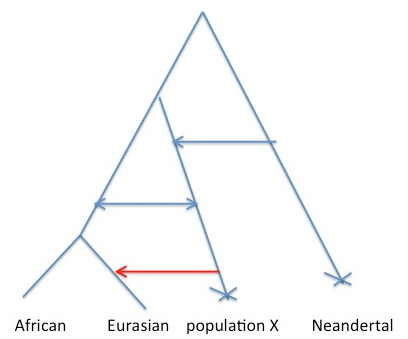
As I say, the authors to their credit take the time in the discussion to point out this caveat. I thought some clarification of why this is the case would be helpful. The tools to address this problem more thoroughly are under development by some of the authors on this paper [Patterson et al 2012] and others [Lawson et al.]. So these tools along with more sequencing of ancient remains will help clarify all of this. It is an exciting time for human population genomics!

* I think I’m right in saying that the intercept of the curve with zero is the only thing that changes between Fig 1A and Fig 1B.

** Note that in the case shown in Figure 2, I think Sriram et al are mostly dating the red arrow, not any of the earlier arrows. This is because they condition their subset of alleles to represent introgression into European and to be at low frequency in Africa. We would likely not be able to date the deeper admixture arrow into the ancestor on Eurasian/Africa using the authors approach, as [I think] it relies on having a relatively non-admixed population to use as a control.
Our paper: A genetic variant near olfactory receptor genes influences cilantro preference

For our next guest post Nick Eriksson (@nkeriks) writes about his ArXived paper with other 23andMe folks: A genetic variant near olfactory receptor genes influences cilantro preference ArXived here

First a little background about research at 23andMe. We have over 150,000 genotyped customers, a large proportion of whom answer surveys online. We run GWAS on pretty much everything trait you can think of (at least everything that is easily reported and possibly related to genetics). Around 2010, we started to ask a couple of questions about cilantro: if people like it, and if they perceive a soapy taste to it.

Fast forward a couple of years, and we have tens of thousands of people answering these questions. We start to see an interesting finding: one SNP significantly associated with both cilantro dislike and perceiving a soapy taste. Best of all, it was in a cluster of olfactory receptor genes.

The sense of smell is pretty cool. Humans have hundreds of olfactory receptor genes that encode G protein-coupled receptors. We perceive smells due to the binding of specific chemicals (“odorants”) to these receptors. There are maybe 1000 total olfactory receptors in various mammalian genomes, but it’s not totally clear which are pseudogenes. There has probably been some loss of these genes in humans as our sense of smell has become less critical. These genes appear in clusters in the genome, which makes it pretty hard for GWAS to pick out a specific gene. For example, in the first 23andMe paper, we identified a variant in a different cluster of olfactory receptors that affected whether you perceive a certain smell in your urine after eating asparagus. However, we still don’t know what the true functional variant in that region is.

Luckily, one of the olfactory receptors near our cilantro SNP turns out to be very well studied. It is known to bind to about 30 different aldehydes, including some of the chemicals that give cilantro its famous odor. So at the core this is a pretty simple paper. We found one significant association; it has as good of a functional story as you’ll see in nearly any GWAS. There are a couple of complications, however. First, we studied two related traits: soapy taste detection and cilantro dislike. They’re relatively correlated (r^2 about 0.33), and they are both associated with the same SNP. It looks like the association is stronger with soapy taste detection (and this trait seemed like it would be less influenced by environment than cilantro dislike), so we used soapy taste as the main phenotype.

The second complicated story is our heritability calculation. We saw about 9% heritability (tagged by the SNPs on our array). However, the confidence interval was pretty huge (-3% to 21%). Roughly, you could think of things falling into three heritability classes: high (height, celiac, type 1 diabetes), medium (type 2 diabetes, Crohn’s) and low (lung, colorectal, and maybe breast cancer). I think that’s about as accurate as the current heritability numbers can get. Our calculation puts cilantro soapy-taste detection into the low heritability group. There is the complication that this is only additive heritability tagged by common SNPs, so this phenotype could actually be very heritable, with most of the action coming from rare variants. But in my opinion, that’s doubtful.

Coming out of mathematics, I’ve always posted my papers to preprint servers. Luckily, this fits in well with 23andMe’s mission of making research faster, more participatory, and more fun. We’ve published all our papers so far in open access journals and have posted a couple of them to Nature Preceedings (before it shut down). I also write everything in LaTeX, so posting to the arXiv is a refreshing change (as compared to most biology journals where you have to undergo a conversion from LaTeX to word that makes everything look terrible (a particular pet peeve of mine with PLOS journals, which I otherwise love)).

I’m very curious to see how posting to the arXiv will affect publicity. Our papers tend to get a fair bit of press. However, I don’t know how the press will deal with one opportunity to report on the paper now (when the results are fresh and novel, but published on a site reporters will mostly not know about) and then another opportunity when the paper gets “blessed” via peer review. Because most of our papers are relatively straightforward GWAS (and we have a lot of coauthors here who have read and written a huge number of such papers), I think getting the data out on a preprint server is particularly important. However, we really need a Genetics category in q-bio!

Feedback on the paper would be most welcome. I’d love to see a replication or a nice functional study to followup, of course. I also think this is a good example for teaching people about genetics. A number of the issues that come up in this paper are a little tricky, but are good examples for understanding the how difficult it is to predict something based on genetics. On the technical side, I’m most curious if there are methods that might give a nice way of analyzing these two correlated traits together. We’ve tried a few regression based approaches for this sort of problem, but haven’t thought of anything entirely satisfactory.

Nick Eriksson

Our paper: The date of interbreeding between Neandertals and modern humans

This post is by Sriram Sankararaman, Nick Patterson, Heng Li, Svante Pääbo, and David Reich on their paper The date of interbreeding between Neandertals and modern humans arXived here

The relationship between modern humans and archaic hominins such as Neandertals has been the subject of intense debate. The sequencing of a Neandertal genome, a couple of years back (Green et al, Science 2010), showed that Neandertals are more closely related to non-African genomes than African genomes. One possible model consistent with this observation is one involving gene flow from Neandertals to modern non-Africans after the divergence of African and non-African populations. Another model that can explain these observations is one in which the population ancestral to modern humans and Neandertals is structured e.g. imagine that the population ancestral to Neandertals and modern humans consists of three groups, A,B and C, where A,B and C represent the ancestors of modern Africans, non-Africans and Neandertals respectively. The extra proximity of Neandertals to non-Africans over Africans could occur if A and B, and B and C exchanged genes with each other followed by C diverging to form Neandertals, and A and B not completely hybridizing before their divergence to form Africans and non-Africans.

The Neandertal (Green et al, Science 2010) and the Denisova genome (Reich et al, Nature 2010) papers considered the possibility of both models — either scenario was shown to produce the skew in the observed D-statistics (a measure of the excess sharing of alleles across groups) that led to Neandertals appearing closer to non-Africans than Africans. Indeed, a recent paper by Eriksson and Manica (Eriksson and Manica, PNAS 2012) used an Approximate Bayesian Computation framework with D-statistics as the summary statistics and arrived at similar conclusions.

A paper from Monty Slatkin’s group (Yang et al, MBE 2012) attempted to differentiate the two scenarios by using the site frequency spectrum. Yang et al considered the site frequency spectrum in Europeans conditioned on observing a derived allele in Neandertal and an ancestral allele in Africans (termed the doubly-conditioned frequency spectrum, dcfs). They used theory and simulations to show that an ancient structure model produces a linear dcfs. On the other hand, they showed that recent gene flow can produce an excess of rare variants which matches the observed dcfs. Interestingly, they also observed that bottlenecks post gene flow had the effect of making the dcfs linear suggesting that gene flow from Neandertals could not have preceded strong bottlenecks in the non-African populations.

A different idea that we explored was to ask if patterns of linkage disequilibrium (LD) might discriminate the two scenarios. If we could pick out haplotypes that came into modern humans from Neandertal, recombination is expected to break these haplotypes down at a fixed rate every generation (assuming neutrality). Haplotypes that came in 1000 generations ago (under recent gene flow) should be expected to be 10 times longer on average than haplotypes that came in 10000 generations ago (under ancient structure). And if we could measure LD precisely enough, we could even date these ancient events. To date such ancient events, we had to address two technical challenges : i) measures of LD can be sensitive to demographic events, ii) for events that occurred 1000s of generations ago, we need to measure LD at size scales at which genetic maps can be quite noisy and this noise can bias estimates of dates.

Theory indicates that the expected LD (measured by Lewontin’s D), across SNPs that arose on the Nenadertal lineage and introgressed, decays exponentially with genetic distance at a rate given by the time of gene flow and is robust to demographic events. This result does not hold in practice due to imperfect ascertainment of these SNPs. We did simulations to show that this decay of LD does provide accurate estimates and can differentiate gene flow and ancient structure. We also came up with a model to assess errors in genetic maps which we then used to obtain a corrected date.

Our results support the recent gene flow scenario with a likely date of gene flow into the ancestors of modern Europeans 37000-86000 years BP although this does not exclude the possibility of ancient structure. A broader methodological question we are exploring is whether LD-based analyses might be generally applicable as a tool for dating other ancient gene flow events.

Sriram Sankararaman, Nick Patterson, Heng Li, Svante Pääbo, and David Reich

An experimental test for genetic constraints in Drosophila melanogaster

An experimental test for genetic constraints in Drosophila melanogaster
Ian Dworkin, David Tack, Jarrod Hadfield
(Submitted on 7 Sep 2012)

In addition to natural selection, adaptive evolution requires genetic variation to proceed. Yet the G-matrix may have limited ‘genetic degrees of freedom’, with certain combinations of trait values unavailable to evolution. Such limitations are often referred to as genetic constraints. Unfortunately, clear predictions about when to expect constraints are rarely available. Therefore, we developed an experimental system that provides specific predictions regarding constraints. Such tests are important as disagreements persist regarding the evidence for genetic constraints, possibly due to differences in methodology, study system or both. Numerous measures of genetic constraints have been suggested, and generally focus on whether some axes of G have eigenvalues=~0, indicating a lack of genetic variance.The mutation Ultrabithorax1 causes a mild homeotic transformation of segmental identity. We predicted that this mutation would induce a genetic constraint due to this homeosis. We measured genetic co-variation for a set of traits in a panel of strains with and without Ubx1. As expected, Ubx1 induced homeotic transformations, and altered patterns of allometry. Yet, no changes in correlational structure nor in the distribution of eigenvalues of G were observed. We discuss the role of using genetic manipulations to refine hypotheses of constraints in natural systems.

Polygenic Modeling with Bayesian Sparse Linear Mixed Models

Polygenic Modeling with Bayesian Sparse Linear Mixed Models
Xiang Zhou, Peter Carbonetto, Matthew Stephens
(Submitted on 6 Sep 2012)

Both linear mixed models (LMMs) and sparse regression models are widely used in genetics applications, including, recently, polygenic modeling. These two approaches make very different assumptions, so are expected to perform well in different situations. However, in practice, for a given data set one typically does not know which assumptions will be more accurate. Motivated by this, we consider a hybrid of the two, which we refer to as a “Bayesian sparse linear mixed model” (BSLMM) that includes both these models as special cases. We address several key computational and statistical issues that arise when applying BSLMM, including appropriate prior specification for the hyper-parameters, and a novel Markov chain Monte Carlo algorithm for posterior inference. We apply BSLMM and compare it with other methods for two polygenic modeling applications: estimating the proportion of variance in phenotypes explained (PVE) by available genotypes, and phenotype (or breeding value) prediction. For estimating PVE, we demonstrate that BSLMM combines the advantages of both standard LMMs and sparse regression modeling. For phenotype prediction it considerably outperforms either of the other two methods, as well as several other large-scale regression methods previously suggested for this problem. Software implementing our method is freely available from this http URL

Our paper: Population genomics of sub-Saharan Drosophila melanogaster: African diversity and non-African admixture

[This author post is by John Pool on his paper: Population genomics of sub-Saharan Drosophila melanogaster: African diversity and non-African admixture arXived here.]

We are in the process of publishing this analysis of >100 sequenced Drosophila melanogaster genomes (largely haploid genomes at >25X depth).  These genomes come from more than 20 geographic locations, largely within sub-Saharan Africa, where the species is thought to originate.  Truth be told, this sampling scheme was somewhat accidental – we wanted to identify a population representing a “center of genetic diversity” for the species, which for us involved sequencing small numbers of genomes from many different population samples (some from previous lab stocks, others from newly collected lines).  Ultimately we did find the sample we were looking for, and we are in the process of sequencing ~300 genomes from this Zambian population.  Still, it seemed more than worthwhile to analyze the “geographic scatter” of genomes we had obtained from across sub-Saharan Africa (as well as one small sample from Europe).

Our ambitions for this paper were largely descriptive – a preliminary analysis of genetic variation within and among the sampled populations.  We envisioned being able to compare diversity levels and genetic structure across Africa (much as I once did with a dramatically smaller data set), and to identify specific loci with signatures of selection.  And we were able to do that.  We found the highest levels of genetic diversity in and around Zambia, raising the prospect of a southern-central African origin for D. melanogaster.  We found low-to-moderate levels of genetic structure across most of sub-Saharan Africa, with only Ethiopian populations showing stronger genetic differentiation (along with some morphological differentiation, but that’s another story).  Analyses of allele frequencies within and between populations revealed a substantial number of loci with evidence of recent natural selection – many GO categories enriched for such outliers pertained to gene regulation, much as we had observed in another recent population genomic analysis.

Of course that’s how we normally think of natural selection’s influence on genetic variation – specific beneficial mutations leading to selective sweeps (whether hard or soft, partial or complete), each one influencing diversity on a limited genomic scale.  And at least in
species with large outbreeding populations like Drosophila, recurrent hitchhiking may be common enough to affect diversity at random sites in the genome (e.g. 1, 2, 3).  So we weren’t surprised to find sweep signals.  The bigger surprise to us was finding evidence that specific episodes of natural selection had affected genetic variation on the scale of whole chromosome arms or the entire genome.

The first major surprise concerned genomic patterns of non-African admixture in African D. melanogaster populations.  The occurrence of such introgression had been documented before, and there were previous findings that non-African genotypes were associated with urban environments in Africa, and that admixture levels could vary within the genome. We developed a hidden Markov model approach to detect admixed chromosomal regions (based simply on the reduced diversity found in populations outside sub-Saharan Africa).  Whereas we tend to think of admixture as a selectively neutral force, the genomic patterns of admixture we observed did not seem consistent with passive gene flow.  Non-African genotypes had displaced large portions of the gene pool of presumably quite large African populations, and this had occurred within a very short time (judging by the megabase scale of admixture tracts).  Levels of admixture across the genome showed both broad-scale heterogeneity (chromosomal differences) and relatively narrow “spikes” of admixture.  These peaks of admixture quite often overlapped with outliers for high FST between Africa and Europe, as would be expected if these regions contained functional differences between populations for which introgressing non-African alleles may now be favored in some African environments (e.g. modernizing cities).  

The second surprise came as we documented population genetic patterns associated with polymorphic inversions (as further analyzed in a forthcoming paper by Russ Corbett-Detig and Dan Hartl).  It was already known that inversions tend to differ in frequency between D. melanogaster populations, but theory and most empirical data suggested that only diversity around the inversion breakpoints should be affected.  Instead, we observed some African populations in which elevated inversion frequencies were associated with notable reductions in diversity for entire chromosome arms (and ultimately affecting genome-wide average diversity), consistent with directional selection on rearrangements or linked loci.  Perhaps more surprisingly, mostinversions found in the non-African sample (France) served to substantially increase diversity across whole chromosome arms (by up to 29% in the case of inversions on arm 3R), and by 12% genome-wide.  Here, we can only suggest that selection may have acted to favor inverted chromosomes that recently originated from a more genetically diverse (e.g. African or African-admixed) population.  Accounting for these inversions substantially alters chromosomal diversity ratios between African and European populations.

Hence, we may have the curious situation of natural selection driving introgression in both directions across the sub-Saharan/cosmopolitan population genetic divide in D. melanogaster.

You can find our draft manuscript here, supplemental items here, and the data here.

 I’m definitely glad we were able to post a draft at arXiv – it was time to communicate our findings to the research community (especially to facilitate our colleagues’ analysis and publication plans for this data set), and there’s really no downside to us as authors.  I also appreciate the chance to post here at Haldane’s Sieve, and it would be great to discuss any aspect of our draft.

John Pool