Reconstructing Roma history from genome-wide data

Reconstructing Roma history from genome-wide data

Priya Moorjani, Nick Patterson, Po-Ru Loh, Mark Lipson, Péter Kisfali, Bela I Melegh, Michael Bonin, Ľudevít Kádaši, Olaf Rieß, Bonnie Berger, David Reich, Béla Melegh
(Submitted on 7 Dec 2012)

The Roma people, living throughout Europe, are a diverse population linked by the Romani language and culture. Previous linguistic and genetic studies have suggested that the Roma migrated into Europe from South Asia about 1000-1500 years ago. Genetic inferences about Roma history have mostly focused on the Y chromosome and mitochondrial DNA. To explore what additional information can be learned from genome-wide data, we analyzed data from six Roma groups that we genotyped at hundreds of thousands of single nucleotide polymorphisms (SNPs). We estimate that the Roma harbor about 80% West Eurasian ancestry-deriving from a combination of European and South Asian sources- and that the date of admixture of South Asian and European ancestry was about 850 years ago. We provide evidence for Eastern Europe being a major source of European ancestry, and North-west India being a major source of the South Asian ancestry in the Roma. By computing allele sharing as a measure of linkage disequilibrium, we estimate that the migration of Roma out of the Indian subcontinent was accompanied by a severe founder event, which we hypothesize was followed by a major demographic expansion once the population arrived in Europe.

Our paper: The genetic prehistory of southern Africa

[This author post is by Joe Pickrell (@joe_pickrell), Nick Patterson, Mark Stoneking, David Reich, and Brigitte Pakendorf on The genetic prehistory of southern Africa, available from arXiv here]

The indigenous populations of southern Africa are phenotypically, linguistically, culturally, and genetically diverse. Although many groups speak Bantu languages (having arrived in the region during an expansion of Iron-Age agriculturalists), there are a number of populations who speak diverse non-Bantu languages with heavy use of click consonants. We refer to these populations as “Khoisan“. Most of the Khoisan populations are hunter-gatherers, but some are pastoralists; the extensive linguistic and cultural diversity of the Khoisan (who live in a relatively small region around the Kalahari semi-desert) is historically puzzling.

Two hunter-gatherer (or formerly hunter-gatherer) populations in East Africa, the Hadza and Sandawe, also speak languages that also make use of click consonants. Linguists see little in common between the languages in southern Africa and Hadza, although Sandawe might be genealogically related to some of the Khoisan languages. Nevertheless, the shared use of click consonants and a foraging lifestyle led many to hypothesize that the southern African Khoisan populations are genetically related to the Hadza and Sandawe, which would imply that their ancestors were once considerably more widespread. This hypothesis has been controversial for decades.
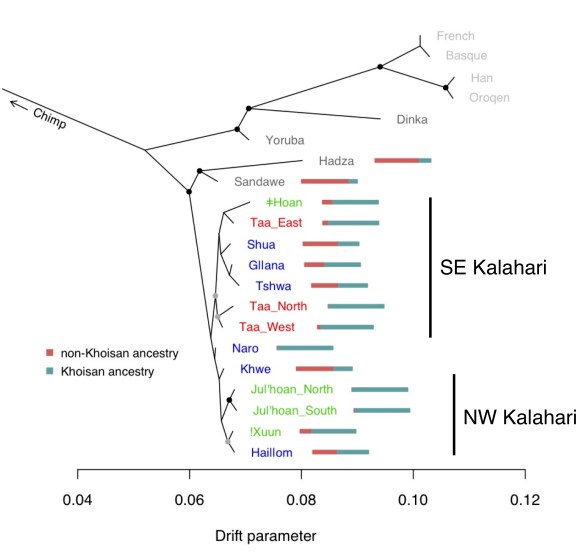
Tree relating the Khoisan-like proportion of ancestry (shown in blue in the barplot) in Khoisan, Hadza, and Sandawe after accounting for non-Khoisan admixture.

In our study, we use genetic data to address the history of the diverse groups within southern Africa and their relationship to the Hadza and Sandawe. Specifically, we genotyped individuals from 16 Khoisan populations, 5 neighboring populations that speak Bantu languages, and the Hadza (the latter thanks to Brenna Henn, Joanna Mountain, and Carlos Bustamante) on a SNP array designed for studies of human history, in that the SNP ascertainement scheme is known and includes SNPs ascertained in the Khoisan. We then merged in Hadza and Sandawe samples from a recent paper by Joseph Lachance, Sarah Tishkoff and colleagues. The main conclusions are as follows:

  1. Within the southern African Khoisan, there are two genetic groups, which correspond roughly to populations in the northwest and southeast Kalahari semi-desert. Populations from these two groups have been labeled in the tree in this post (see also Figure 1B in the preprint). We estimate that these two groups diverged within the last 30,000 years. However, this date should be taken as an upper bound due to point #2 below.
  2. All southern African Khoisan groups are admixed with non-Khoisan populations. Even the most isolated Khoisan groups (i.e. the “San” from the HGDP, who are included in the “Ju|’hoan_North” group in our paper) show some evidence of admixture with agricultualist and/or pastoralist groups. A subtle technical point is that this had not been previously noticed because methods that rely on correlations in allele frequencies are sometimes unable to detect admixture if all populations are admixed (this is related to Mr. Razib Khan’s post on why ADMIXTURE is not a test for admixure). To get around this, we developed new methods based on the decay of linkage disequilibrum.
  3. The Hadza and Sandawe trace part of their ancestry to admixture with a population related to the Khoisan. After accounting for admixture, we built a tree of “Khoisan-like” ancestry in the southern and eastern African populations (see the Figure above). The striking thing is that the Hadza and Sandawe fall with high confidence on the same branch as the Khoisan. This suggests that, prior to subsequent migrations of food-producing peoples over most of sub-Saharan Africa, populations related to the Khoisan were indeed spread continuously over a huge geographic range including Tanzania and southern Africa.

We’re excited about these results for a number of reasons. First of all, we’re now on our way towards understanding the history of the diverse Khoisan populations–for years these populations have been treated as genetically equivalent, but it’s clear that each population has its own complex history. Secondly, with the new statistical methods we’ve developed we were able to show not only the varying amounts of admixture that has occurred at different times in southern African populations, but were also able to peel away these layers of admixture to learn about the relationships among Khoisan populations that existed thousands of years ago. Finally, we think that these results have important implications for work using genetics to understand the geographic origin of modern humans within Africa. Though both southern and eastern Africa have been proposed as potential origins, from the tree in this post, we see no genetic evidence in favor of either; from our point of view this question remains open.

Joe Pickrell, Nick Patterson, Mark Stoneking, David Reich, and Brigitte Pakendorf

The geography of recent genetic ancestry across Europe

The geography of recent genetic ancestry across Europe

Peter Ralph, Graham Coop
(Submitted on 16 Jul 2012 (v1), last revised 19 Jul 2012 (this version, v2))

The recent genealogical history of human populations is a complex mosaic formed by individual migration, large-scale population movements, and other demographic events. Population genomics datasets can provide a window into this recent history, as rare traces of recent shared genetic ancestry are detectable due to long segments of shared genomic material. We make use of genomic data for 2,257 Europeans (the POPRES dataset) to conduct one of the first surveys of recent genealogical ancestry over the past three thousand years at a continental scale. We detected 1.9 million shared genomic segments, and used the lengths of these to infer the distribution of shared ancestors across time and geography. We find that a pair of modern Europeans living in neighboring populations share around 10-50 genetic common ancestors from the last 1500 years, and upwards of 500 genetic ancestors from the previous 1000 years. These numbers drop off exponentially with geographic distance, but since genetic ancestry is rare, individuals from opposite ends of Europe are still expected to share millions of common genealogical ancestors over the last 1000 years. There is substantial regional variation in the number of shared genetic ancestors: especially high numbers of common ancestors between many eastern populations likely date to the Slavic and/or Hunnic expansions, while much lower levels of common ancestry in the Italian and Iberian peninsulas may indicate weaker demographic effects of Germanic expansions into these areas and/or more stably structured populations. Recent shared ancestry in modern Europeans is ubiquitous, and clearly shows the impact of both small-scale migration and large historical events. Population genomic datasets have considerable power to uncover recent demographic history, and will allow a much fuller picture of the close genealogical kinship of individuals across the world.

Our paper: Blood ties: ABO is a trans-species polymorphism in primates

[This author post is by Laure Ségurel [a postdoc in the Przeworski Lab] on the paper Blood ties: ABO is a trans-species polymorphism in primates, posted on the arXiv here]

The mysteries of the ABO blood group were first brought to our attention by Carole Ober. When we started working on it, we were mostly surprised by how little was known about the function of such a heavily studied gene and such an important clinical phenotype. Indeed, the expression of A, B and/or O antigens at the surface of some cells is a polymorphic phenotype shared by species as diverse as macaques and baboons in Africa, gibbons in Asia, squirrel monkeys in the Americas and, of course, humans throughout most of the world yet, many questions remain unanswered, such as: What is the biological role of ABO in different cell types? Why did Hominoids evolve toward its expression of blood cells whereas other primates express it only on epithelial/endothelial cells? Why is the O allele at such high frequency only in humans? What are the selective agents responsible for the maintenance of this polymorphism? And why did chimpanzees and bonobos apparently loose the polymorphism?

One question that we became interested in answering with population genetic tools was that of the origin of such blood types. When did the genetic polymorphism first emerge and which species share it identical by descent (as opposed to by convergent evolution)? Answers to these questions could tell us where and when having multiple alleles at this locus became advantageous. We therefore sequenced as many Hominoids, Old World monkeys and New World monkeys we could get our hands on, and, even more interestingly, we started thinking about the expectations under a model of convergent evolution, i.e., one where the AB genetic polymorphism was created independently multiple times in different species (and then maintained by balancing selection in these lineages) versus under a model of trans-species polymorphism, i.e., in which the AB genetic polymorphism arose early in time and was transmitted identical by descent to distinct species. Key to distinguishing the two predictions is the age of different selected alleles within a polymorphic population.

We therefore compared alleles within humans, orangutans, gibbons, macaques, baboons and colobus monkeys (all polymorphic species for the A and B alleles), and showed that, at least among Hominoids and among Old World monkeys, the observed genetic pattern is not compatible with a model of convergent evolution but on the contrary matches the expectations under a model of a trans-species polymorphism maintained by multi-allelic balancing selection. In other words, the data indicate that the AB polymorphism was present at least around 20 Millions of years ago, if not earlier. Also, interestingly, it seems that the A, B and O functional classes do not provide a complete description of the allelic classes natural selection is acting on, which underscores the need for more detailed functional studies of ABO sub-groups.

By submitting the paper to arXiv, we hope to circulate it to a diverse audience and without delay. In particular, we hope that the study will motivate more experimental/functional work about the role of this polymorphism in immune response, e.g., to pathogen infections.

Laure Ségurel

Inference of population splits and mixtures from genome-wide allele frequency data

Inference of population splits and mixtures from genome-wide allele frequency data

Joseph K. Pickrell, Jonathan K. Pritchard
(Submitted on 11 Jun 2012)

Many aspects of the historical relationships between populations in a species are reflected in genetic data. Inferring these relationships from genetic data, however, remains a challenging task. In this paper, we present a statistical model for inferring the patterns of population splits and mixtures in multiple populations. In this model, the sampled populations in a species are related to their common ancestor through a graph of ancestral populations. Using genome-wide allele frequency data and a Gaussian approximation to genetic drift, we infer the structure of this graph. We applied this method to a set of 55 human populations and a set of 82 dog breeds and wild canids. In both species, we show that a simple bifurcating tree does not fully describe the data; in contrast, we infer many migration events. While some of the migration events that we find have been detected previously, many have not. For example, in the human data we infer that Cambodians trace approximately 16% of their ancestry to a population ancestral to other extant East Asian populations. In the dog data, we infer that both the boxer and basenji trace a considerable fraction of their ancestry (9% and 25%, respectively) to wolves subsequent to domestication, and that East Asian toy breeds (the Shih Tzu and the Pekingese) result from admixture between modern toy breeds and “ancient” Asian breeds. Software implementing the model described here, called TreeMix, is available at this http URL

The variance of identity-by-descent sharing in the Wright-Fisher model

The variance of identity-by-descent sharing in the Wright-Fisher model

Shai Carmi, Pier Francesco Palamara, Vladimir Vacic, Todd Lencz, Ariel Darvasi, Itsik Pe’er
(Submitted on 21 Jun 2012)

Widespread sharing of long, identical-by-descent (IBD) genetic segments is a hallmark of populations that have experienced a recent bottleneck. The detection of these IBD segments is now feasible, enabling a wide range of applications from phasing and imputation to demographic inference. Here, we study the distribution of IBD sharing in the Wright-Fisher model. Using coalescent theory, we calculate the mean and variance of the total sharing between arbitrary pairs of individuals. We then study the cohort-averaged sharing: the average total sharing between one individual to the rest of the cohort. We find that for large cohorts, the cohort-averaged sharing is distributed approximately normally. Surprisingly, the variance of this distribution remains large even for large cohorts, implying the existence of “hyper-sharing” individuals. The presence of such individuals bears important consequences to the design of sequencing studies, since, if they are selected for whole-genome sequencing, a larger fraction of the cohort can be subsequently imputed. We calculate the expected gain in power of imputation by IBD, and subsequently, in power to detect an association, when individuals are either randomly selected or are specifically the hyper-sharing individuals. Finally, we study the distribution of pairwise sharing and cohort-averaged sharing in the Ashkenazi Jewish population.

Population genomics of the Wolbachia endosymbiont in Drosophila melanogaster

Population genomics of the Wolbachia endosymbiont in Drosophila melanogaster

Mark F. Richardson, Lucy A. Weinert, John J. Welch, Raquel S. Linheiro, Michael M. Magwire, Francis M. Jiggins, Casey M. Bergman
(Submitted on 25 May 2012 (v1), last revised 2 Aug 2012 (this version, v2))

Wolbachia are maternally-inherited symbiotic bacteria commonly found in arthropods, which are able to manipulate the reproduction of their host in order to maximise their transmission. Here we use whole genome resequencing data from 290 lines of Drosophila melanogaster from North America, Europe and Africa to predict Wolbachia infection status, estimate cytoplasmic genome copy number, and reconstruct Wolbachia and mtDNA genome sequences. Complete Wolbachia and mitochondrial genomes show congruent phylogenies, consistent with strict vertical transmission through the maternal cytoplasm and recurrent loss of Wolbachia in multiple populations. Bayesian phylogenetic analysis reveals that the most recent common ancestor of all Wolbachia and mitochondrial genomes in D. melanogaster dates to around 8,000 years ago. We find evidence for a recent incomplete global replacement of ancestral Wolbachia and mtDNA lineages, which is likely to be one of several similar incomplete replacement events that have occurred since the out-of-Africa migration that allowed D. melanogaster to colonize worldwide habitats.

The Genomic Signature of Crop-Wild Introgression in Maize

The Genomic Signature of Crop-Wild Introgression in Maize
Matthew B. Hufford, Pesach Lubinksy, Tanja Pyhäjärvi, Michael T. Devengenzo, Norman C. Ellstrand, Jeffrey Ross Ibarra
(Submitted on 19 Aug 2012)

The evolutionary significance of hybridization and introgression has long been appreciated, but evaluation of the genome-wide effects of these phenomena has only recently become possible. Crop-wild study systems represent ideal opportunities to examine evolution through hybridization. For example, maize and the conspecific wild teosinte Zea mays ssp. mexicana are known to hybridize in the fields of highland Mexico. Despite widespread evidence of gene flow, maize and mexicana maintain distinct morphologies and have done so in sympatry for thousands of years. Neither the genomic extent nor the evolutionary importance of introgression between these taxa is understood. We assessed patterns of genome-wide introgression based on 39,029 single nucleotide polymorphisms genotyped in 189 individuals from nine sympatric maize-mexicana populations and reference allopatric populations. While portions of these genomes were particularly resistant to introgression (notably near known cross-incompatibility and domestication loci), we detected widespread evidence for introgression in both directions of gene flow. Through further characterization of these regions and a growth chamber experiment we found evidence consistent with the incorporation of adaptive mexicana alleles into maize during its expansion to the highlands of central Mexico. In contrast, very little evidence was found indicating introgression from maize to mexicana altered the niche of this wild taxon, increasing its capacity to persist commensal to agriculture. The methods we have applied here can be replicated widely across species, greatly informing our understanding of evolution through introgressive hybridization. Crop species, due to their exceptional genomic resources and frequent histories of diffusion into sympatry with relatives, should be particularly influential in these studies.